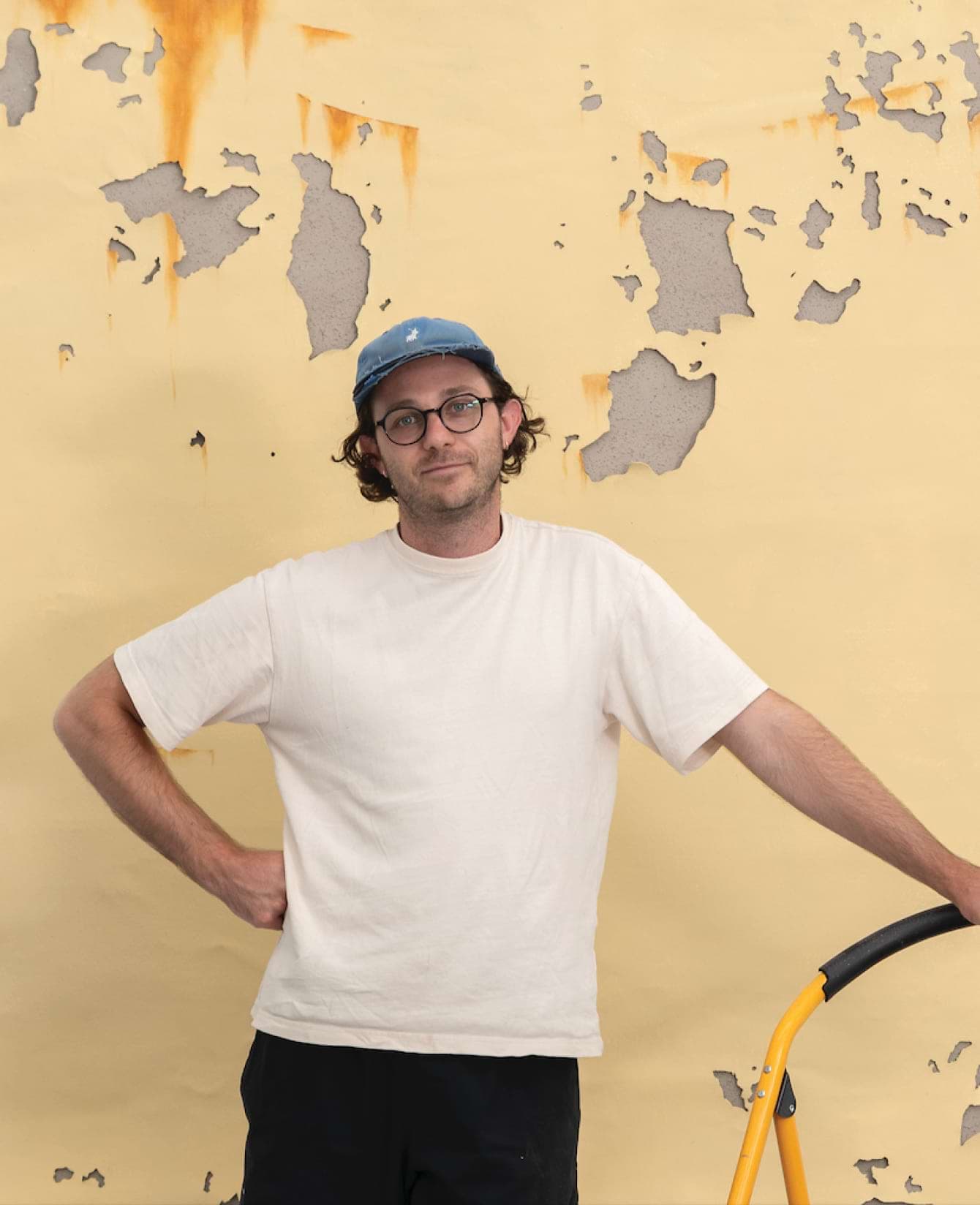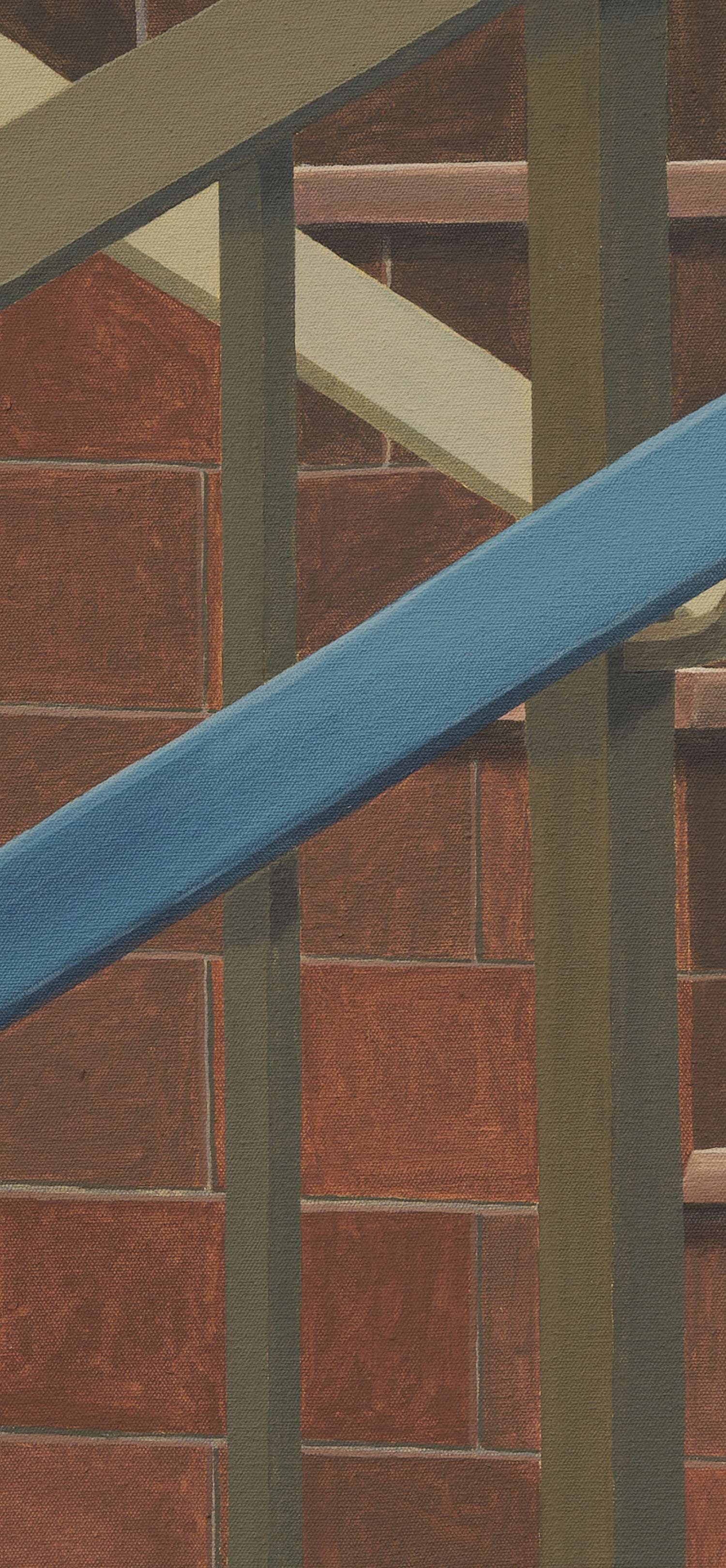
Goodman Gallery Johannesburg is pleased to present Guy’s Simpson’s Was Here, his first gallery presentation in the city where he was born and raised. Emerging from a network of artist-run spaces in Cape Town – where he now lives – Simpson’s practice sits at the unusual intersection of documentation and abstraction, translating photographic record into dense, materially layered and extraordinarily innovative and often sculptural paintings. By focussing on the minutiae of the spaces we inhabit, he offers an understated and beautifully tactile meditation on the transitions of places and communities.


It brings together a small but powerful group of paintings created by Simpson towards the end of 2025. Returning to Johannesburg to show in this context carries particular resonance for the artist: the school bus that took him from the suburb of Sydenham where he lived to the Jewish day school he eventually attended, King David Victory Park, passed Goodman Gallery every morning.
Born in the year that South Africa officially became a democracy, Simpson has witnessed acute examples of Johannesburg’s shifting suburban landscape: shrinking and consolidating diasporic communities; religious and ethnic enclaves tightening after extensive relocation; generational shifts in belief, belonging and identity. Growing up in Orange Grove and the bordering suburb of Sydenham – where he spent most of his school-going years – Simpson experienced these transitions first-hand. Orange Grove – its evocative name recalling the orange farms of a century ago, rather than its more recent blue-collar reality – was home to Jewish, Italian, Portuguese and Afrikaans communities, many of whom have since dispersed. In an earlier body of work, Simpson mapped this changing terrain through paintings of decaying interior and exterior walls, where peeling paint and ruptured plaster operate as inadvertent urban archives.


Simpson’s approach is shaped in part by artists such as Igshaan Adams – for whom he once worked as a studio assistant – whose materially driven practice draws on the textured surfaces of homes in Langa and Bonteheuwel. While Adams’s work maps social and familial histories through woven and salvaged materials, Simpson adopts a different strategy: he mixes aluminium filings, sawdust and reflective glass into his paint to approximate the grit and tactility of deteriorating spaces. His attention to surface detail also resonates with the hyperreal paintings of Brazilian artist Paulo Nimer Pjota, who layers textures and references in what he describes as a form of visual sampling.
In this new body of work, Simpson turns from domestic interiors to the now-empty grounds of his former school, whose recent and controversial closure underscores the contraction of Johannesburg’s Jewish community. Before the site was vacated, he photographed and archived the campus, revisiting his ambivalent relationship to Jewish schooling as a way of thinking through broader shifts in the community – demographic shrinkage, increasing securitisation, and ideological divergences between schools. Although not overtly didactic, Simpson notes that such politics remain embedded in the suburbs and spaces he paints.
The resulting interior works are small, intimate studies that locate slow or quiet moments around the campus. Although they never depict the human figure, they register presence through detail: seats in the synagogue; the corner of a chalkboard; blinds in the assembly hall; and, the small yet telltale sign of Jewish presence, a mezuzah on a doorframe. These paintings are interspersed with larger works of exterior facades, which set the broader scene, as well as a series of subtly slanted compositions derived from the angled walls built along staircases and ramps throughout the school. These tilted works introduce an unexpected architectural rhythm – a sense of movement, elevation and descent – and echo the shifting ground of a place in transition.


Featured Artworks
Create a Goodman Gallery account to view our full selection of available works, access pricing and check out online.